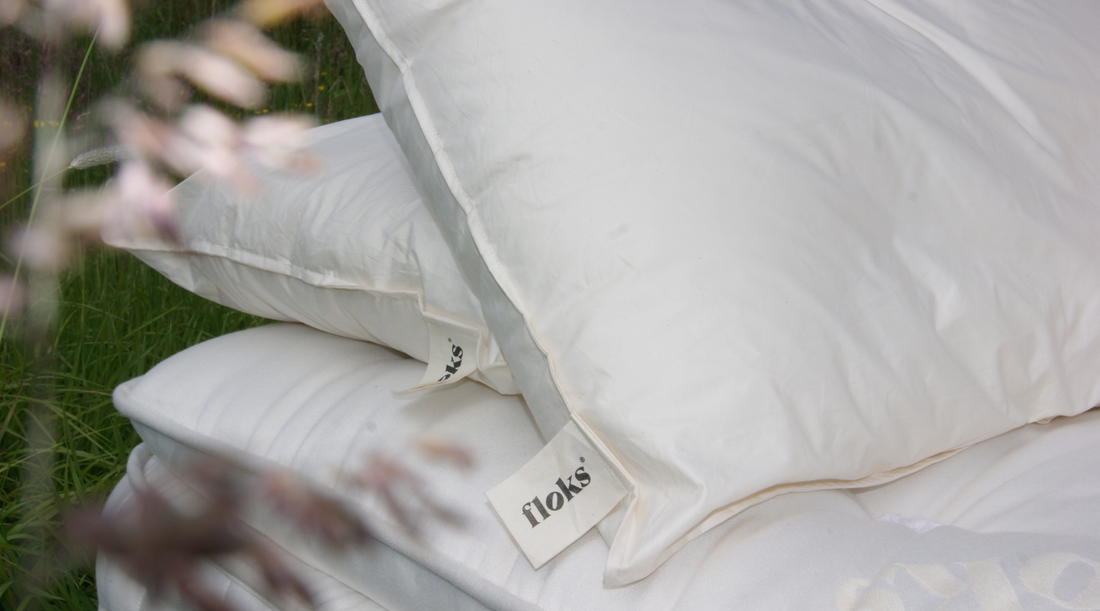
On Earth Day, we're thinking about what we make, where it comes from, and what happens when it's done.
Every year in the UK, around 7 million mattresses are thrown away according to the National Bed Federation. Of those, an estimated 4.75 million end up in landfill or incineration. Add 14 million duvets, pillows and mattress toppers on top of that - most of them synthetic, most of them destined for the same place. Most people don't think about this. Why would you? A mattress disappears from the doorstep and the story ends there. But for Sophie, our founder that question - where does it all go? - is where the Floks story begins.
Why Floks exists
It was 2020. Lockdown. Sophie had spent over 20 years designing and selling products, but she'd been quietly carrying a more personal problem: she couldn't sleep well. She overheated at night, woke in the early hours, and found herself going through bedding that simply wasn't working.
Research led her to wool. She discovered something that felt almost too good to be true: a fibre that regulated temperature naturally, absorbed moisture, kept you dry through the night. But the more she read, the more she realised wool's story didn't end at comfort.

Wool is compostable. Biodegradable. When it's buried or thrown to waste, enzymes in the soil break it down within months, releasing nutrients back into the ground. It doesn't leave a trace. It returns to what it came from. That idea took root.
For Sophie, it was also deeply personal. One grandfather was a Yorkshire farmer. The other worked in Huddersfield's textile trade. The vision of a British bedding company, built on natural materials and local craft galvanised her to design the first ever Floks product – our award-winning duvet.
Floks was born from that convergence - a sleep problem, a remarkable fibre, and two grandfathers who spent their lives working with the land. What's in most bedding - and what happens to it.
The majority of duvets and pillows sold in the UK are filled with synthetic materials: polyester, memory foam, microfibre. They're cheap to make and cheap to buy. But they come with a cost that doesn't appear on the price tag.
Synthetic fibres don't break down. When a synthetic duvet reaches the end of its life - often just a few years - it goes to landfill, where it will remain for decades, sometimes centuries. Every wash releases hundreds of thousands of microplastic fibres into waterways. The bedding industry is, quietly, one of the more persistent contributors to textile waste and plastic pollution.
Natural fibres work differently. Wool, hemp and organic cotton are grown from the earth, and when they're done, they go back to it. No lasting trace. No microplastics. Just the soil they came from.
 The Floks way
All Floks bedding is made using Traceable British wool, sourced from specialist farms and processed within a 20 mile radius - grading, scouring and manufacture all kept close together to keep the carbon footprint low.
The wool itself comes from Cheviot sheep, known for a soft, lofty fleece that makes for genuinely exceptional bedding. Shearing is part of the sheep's natural annual cycle.
Everything ismade in the UK, with makers who've spent their lives in the trade.
 A little something back
To mark Earth Day, all orders placed between midnight tonight until midnight on Friday will come with wildflower seeds from Seed Revolution and a parcel of wool to use however you like.
The seeds are for wherever you can find soil. The wool is yours to use as you like - compost it, stuff a bird feeder, top up your Floks pillow, try some felting.
This is what we believe better sleep looks like: good for you, good for the planet, and honest about where everything comes from and where it ends up.