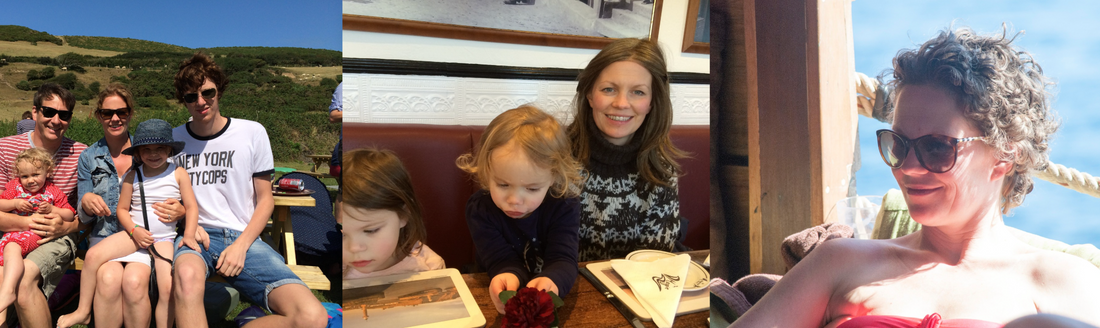
October 2014. My husband’s birthday. Instead of celebrating at home with cake and party-happy children, we were sitting in a strip-lit consultation room at York Hospital’s cancer centre, being told that I had aggressive breast cancer that had already entered my lymphatic system.
I was 39. My children were four and two. My youngest, Flora, used my hair as her comfort blanket, winding her sticky, pudgy little fingers through it whenever she needed reassurance, especially as she drifted off to sleep at night. At the same time as running a business and raising two young children, I was also supporting my mum through the final stages of terminal lymphoma.

Just before, during and after in 2014.
The thing is, I had always been a brilliant sleeper but cancer took that from me almost immediately.
Night terrors became the norm. A racing brain on steroids - quite literally, once treatment began. Survival statistics roamed freely around my mind. I imagined my children’s lives without me. I ruminated endlessly over everything I had ever done that might somehow have caused it.
Eighteen months of every kind of treatment pushed me further; chemotherapy brought on an early menopause. I couldn't take HRT, so I was prescribed tamoxifen instead. If you have ever tried to sleep as a medically-induced menopausal mother - no progesterone, declining oestrogen, cortisol spiking at 3am - you will know that sleep starts to feel like something other people get to have.
There's a reason those nights are so brutal.
Progesterone enhances GABA, the brain’s braking system. When progesterone drops, you become far more sensitive to cortisol signals, which naturally begin to rise around 3am. Under normal hormonal conditions, you sleep straight through it. Without progesterone’s steadying effect, you do not. You wake up. Fully. Unhelpfully alert.
Eleven years on, the what-ifs have settled. And yet those 3am wake-ups still visit more often than I would like!
But I have learned what actually helps, me at least.
A good night’s sleep starts in the morning. It starts with how I move through the day. Walking is the single most reliable thing I have found for regulating my nervous system. The windier and rainier it is outside, the better I seem to feel.
I stopped drinking alcohol. For me, not a rule for anyone else, even one glass disrupts my sleep in a way I can feel by 3am. Alcohol fragments the second half of the night, even when it helps you fall asleep faster.
I eat well. It’s something I can control in a life still full of variables I cannot.
I use magnesium, sprayed onto my legs before bed. Magnesium supports the deep, slow-wave sleep that is essential for physical restoration.
And I sleep under natural fibres.
This has been the most practical thing I have done for night sweats. Wool bedding, paired with hemp and organic cotton linen, regulates temperature in a way synthetic fibres simply do not. For anyone navigating perimenopause or hormonal disruption, that isn’t a luxury, it’s a genuine support.
When I wake in the night, I breathe before I do anything else.
In for four. Hold for seven. Out for eight.
The extended exhale stimulates the vagus nerve - your body’s off switch. You’re not trying to calm your mind; you’re sending a signal to your nervous system that the threat has passed.
And then there is oxytocin. I am slightly obsessed with oxytocin. I am convinced it holds answers to many of life’s challenges.
Most people know it as the “love hormone” associated with birth, breastfeeding, and sex. But its reach is far wider. Oxytocin is essentially cortisol’s opposite. The more you have of one, the less influence the other has.
It suppresses the amygdala, the part of the brain responsible for that familiar 3am catastrophising. It brings cortisol down and supports the immune system.
And the things that produce it are wonderfully simple.
Stroking a dog. A long hug. Time with people who make you feel safe. Even thinking about someone you love can shift your levels. Hugging yourself works too. Oxytocin quite literally changes the chemistry of your brain Our bodies make one of our most important medicines.
Eleven years on, I am not cured of bad nights. But I know what to reach for.
Sleep is not self-indulgence. For women navigating health challenges, hormonal shifts, the demands of running businesses and raising families, it is the foundation on which everything else is built on.